
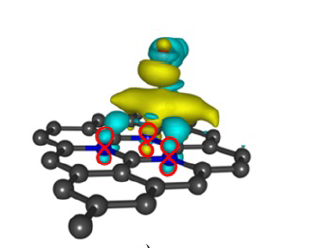


Effects of N-doped concentration in graphene on CO2 adsorption
- Ho Chi Minh City University of Technology (HCMUT), 268 Ly Thuong Kiet Street, District 10, Ho Chi Minh City, Vietnam
- Vietnam National University Ho Chi Minh City, Linh Trung Ward, Ho Chi Minh City, Vietnam
- Institute of Physical Chemistry “Ilie Murgulescu” of the Romanian Academy, Splaiul Independentei 202, Sector 6, 060021 Bucharest, Romania
Abstract
Solving the problem of the environment related to CO2 emission is an urgent and challenging task to prevent the escalation of climate change, which is due to increasing energy demand from fossil fuels and industrial activities. Using graphene to capture CO2 gas is of great interest to mitigate global warming, where CO2 capture by doped graphene has been shown to significantly improve the CO2 adsorption capacity compared to that of pure graphene. In particular, N-doped graphene is a unique structure that was suggested for CO2 capture by the adsorption phenomenon. However, there is no research available to clarify nitrogen doping concentration in graphene on CO2 adsorption. Therefore, this work has been devoted to elucidating the problem using the density functional theory method considering van der Waals interaction. We showed that increasing the doping content of nitrogen by 3.1, 6.3, 9.4, and 12.5% will increase the CO2 adsorption energy, monotonically for N content below 9.4% and significantly for 12.5%. The most favorable adsorption configuration of the CO2 molecule should be parallel to the surface of the N-doped graphene. The structure of the substrate at 12.5% N distorted upon the CO2 adsorption; therefore, the substrate is more active for CO2 capture. The physical meaning underlying the interaction of the N@graphene system is physisorption, which is due to the contribution of the N pz state and the CO2 pz state along the surface normal of the substrate. Increasing the N-doping content shifts down the unoccupied states of the N pz orbital in the conduction band across the Fermi level to the valence band. Hence, the population of the occupied state at the Fermi level increases as increasing the N-doping concentration, leading to the stronger interaction of the CO2 molecule with the N@graphene substrate. The results should be useful for the rational design of suitable N@graphene substrates for CO2 capture and storage applications.