


Investigation of Bleaching Stage in Cellulose Isolation from Pineapple Leaves for Cellulose Nanocrystals Production

- Faculty of Chemical Engineering, Ho Chi Minh City University of Technology (HCMUT), 268 Ly Thuong Kiet Street, District 10, Ho Chi Minh City, Vietnam
- Vietnam National University Ho Chi Minh City, Linh Trung Ward, Thu Duc City, Ho Chi Minh City, Vietnam
- Institute for Tropicalization and Environment, 57A Truong Quoc Dung Street, Phu Nhuan District, Ho Chi Minh City, Vietnam
Abstract
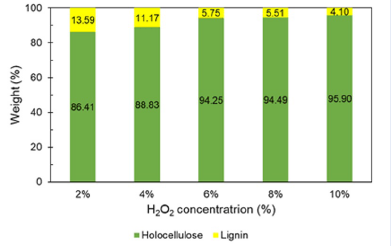
Nanocrystalline cellulose has emerged as a substantial nanomaterial in recent years due to its peculiar characteristics such as bio renewability, sustainability, and low toxicity while having high mechanical strengths, optical transparency, and much more. Meanwhile, pineapple leaves (PL) as by-products after fruit harvest exhibit a huge potential in cellulose and nanocellulose extraction due to their high cellulose content (approx. more than 36%). The latest studies have successfully recovered cellulose from pineapple leaves, in which the bleaching stage greatly affects the properties of the produced cellulose. In some cases, this stage can result in a reduction in cellulose content because of the excessive use of chemicals. However, the effects of influential factors such as solid-liquid ratio, reaction time, and reagent concentration in the bleaching stage have not been widely investigated although they are necessary to scale up the cellulose recovery process. In this study, cellulose was extracted from PL using alkali treatment with sodium hydroxide and bleaching with hydrogen peroxide before synthesizing nanocellulose. The characterization of PL, cellulose, and nanocellulose was performed by Thermogravimetry Analysis (TGA), Fourier Transform spectroscopy (FTIR), X-ray diffraction (XRD), Transmission Electron Microscope (TEM) and Dynamic Light Scattering (DLS). The results indicated that bleaching with H2O2 at 6% after 60 min at a solid-liquid ratio of 1:20 yielded an impressively high cellulose content of 94.25%. Obtained nanocellulose possessed high crystallinity index of approx. 80% with a diameter in the range of 15-30 nm. Along with further research related to the application of organic nanoparticles, this study has a great impact on the proposing processes with better stability, which is meaningful in terms of green chemistry towards sustainable development by satisfying most principles of this theory.