


Regularized local damage model for quasi-brittle material
- Faculty of Civil Engineering, Ho Chi Minh City University of Technology (HCMUT), 268 Ly Thuong Kiet Street, District 10, Ho Chi Minh City, Vietnam
- Vietnam National University Ho Chi Minh City, Thu Duc City, Ho Chi Minh City, Vietnam
- Duy Tan Institute for Computational Engineering (DTRICE), Duy Tan University, Ho Chi Minh City, Vietnam
- Faculty of Civil Engineering, Duy Tan University, Da Nang, Vietnam
Abstract
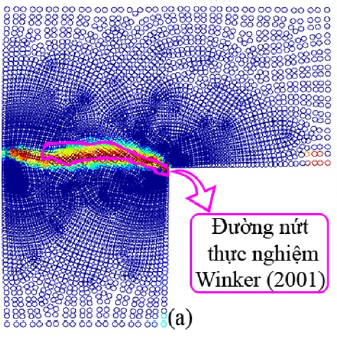
This paper presents an improved local damage model for quasi-brittle materials. A parameter, namely damage, in the range [0,1] is used to characterize the material from intact state to complete failure. Classical local damage model is known for low computational cost but it suffers from numerical issues such as difficult convergence and mesh-density-dependent results. Various non-local models have therefore been proposed, however the computational cost is increased, which hinders the applicability in practical problems. Furthermore, the width of the damage zone predicted by the non-local models is usually non-physically large. Here, the improvement is the introduction of the fracture energy and element-size into the calculation of damage parameters to mitigate the weakness of the local damage model, while keeping low computational cost. The employment of polygonal element is also proposed to utilize the advantage of high-accuracy, thus less number of elements (than the usual 3-node triangular or 4-node quadrilateral elements) can be used. The bi-energy norm-based equivalent strain is for the first time considered in a local damage model. This quantity is based on the maximum strain criterion, but with a modification to take into account the property of quasi-brittle materials such as concrete, limestone, etc., that load capacity in compression is higher than in tension. Accuracy and efficiency of the proposed model is investigated through comparison with reference results from experiments and other numerical methods.