


The influence of fluid-structure interactions 2-ways on dynamic characteristics of flexible tank
- Faculty of Civil Engineering, HCMC Unversity of Technology and Education, HCMC, Viet Nam
- Faculty of Civil Engineering, HCMC University of Technology and Education, HCMC, Vietnam
- Trường Đại học Bách Khoa - ĐHQG-HCM
Abstract
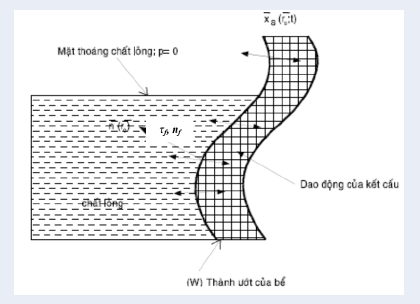
This paper investigates the influence of two-way fluid-structure interactions (FSI) on the dynamic characteristics of flexible storage liquid tanks. A coupled finite volume method FVM and finite element method FEM (FVM/FEM) was developed to simulate a flexible water tank subjected to seismic loading. FVM is used to simulate the fluid domain and FEM is used to capture the structural domain. The two-dimensional interaction equation is solved at the contact surface between the elastic tank wall and the fluid by tuning the relaxation parameter and convergence conditions. The model investigates the influence of considering two-way FSI on the dynamic characteristics of a tank flexible to a rigid tank wall. The results show that the frequency of flexible tank walls differs from that of rigid walls, especially the hydrodynamic pressure of liquid motion acting on the tank. A “threshold value” is revealed to distinguish flexible or rigid tanks. If the tank stiffness exceeds this threshold, then the thicker the tank is, the lower the hydrodynamic pressure. However, if the tank stiffness is less than this threshold, the thinner the tank is, the lower the hydrodynamic pressure. Further experiments on a fluid container under harmonic excitation are carried out using a shaking table to verify the dynamic behavior in comparison to numerical results. Good agreement is observed between numerical, analytical, published, and experimental data.