

Application of infrared technique and deep learning in detecting early dental lesions
- Ho Chi Minh City University of Technology, VNU-HCM
- Industrial University of Ho Chi Minh City
- Quoc An Dental Clinic, Ho Chi Minh City
Abstract
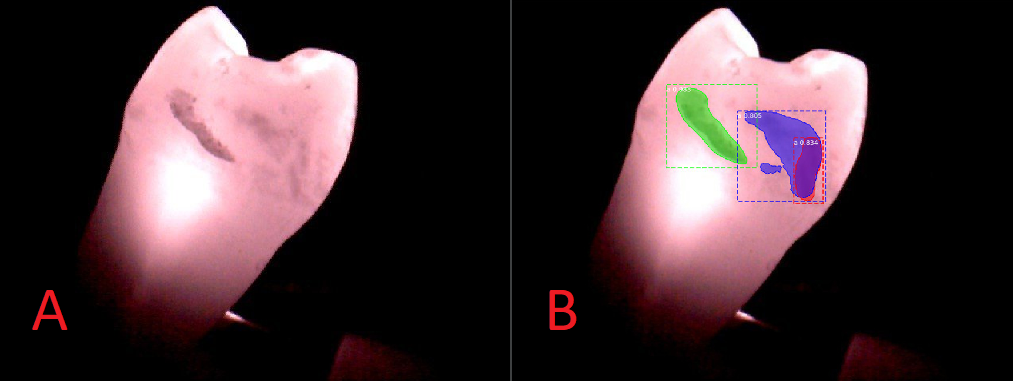
Recently, in dentistry the infrared technique has been developed strongly to detect dental lesions, based on the fact that the optical properties of damaged tissue under infrared light are significantly different from those of sound dental tissue. Meanwhile, a number of research groups have paid attention to the application of deep learning strategies for classifying and analyzing infrared image data. The aim of the present study was to introduce the application of infrared technique and deep learning in detecting dental lesions. In this study, the optical systems with 850-nm LEDs which were applied for infrared imaging, were designed and used for diagnosing in vitro different types of early-stage lesions such as occlusal plaque, approximal plaque and white spot lesion. Two deep learning models (Unet and Mask R-CNN) were used for training and identifying the presence of lesions in 1367 near-infrared images. The results suggest the effectiveness of Unet and Mask R-CNN models in diagnosing dental lesions via infrared images.