


Research, experiment and comparison of single axis and dual axes solar tracking to increase solar panel power capacity
- Department of Heat and Refrigeration Engineering, Ho Chi Minh City University of Technology (HCMUT), 268 Ly Thuong Kiet Street, District 10, Ho Chi Minh City, Viet Nam
- Vietnam National University Ho Chi Minh City, Linh Trung Ward, Thu Duc District, Ho Chi Minh City, Viet Nam
Abstract
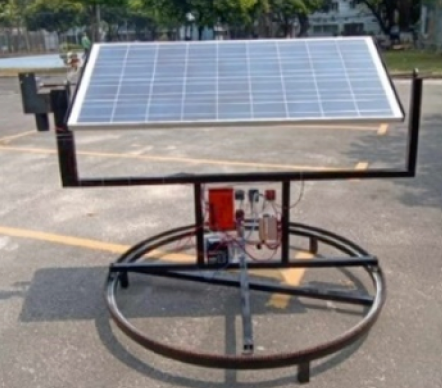
A simulation program combined with experimental testing of three solar panel tracking systems along one axis and two dual axes will be introduced in this article. Solar panel systems are widely used today, but to achieve high performance, it is necessary to design solar panel systems that can automatically align themselves perpendicularly to the incident radiation to optimize their efficiency. Therefore, the application of solar panel tracking systems not only increases the generated electrical power but also helps improve the current state of depletion of fossil fuel resources. Based on actual measurement results and simulated data, the article demonstrates that the electrical power output of solar panels increases by 3.96% when a dual-axis tracking system is applied compared to a one-axis tracking system, and it increases by 36.8% compared to a fixed 15° tilt-angle panel, a common angle in Vietnam. Furthermore, based on the geometric angle relationships between the Sun and the inclined plane, the research team also applied a simulation program to investigate the different efficiencies of continuous tracking models throughout a year in Ho Chi Minh City, Vietnam. The results show that in August, when the Sun is at its highest position, the efficiency difference between the two models is not significant, at 3.4%. However, when the Sun is in a lower position in January, the efficiency difference is more pronounced, with the two-axis tracking system being 45.9% more efficient than the one-axis system.