


Investigate the effect of partial replacement of NaCl with KCl on salty perception and preference in Vietnamese pumpkin soup and tomato soup
- Ho Chi Minh City University of Technology
Abstract
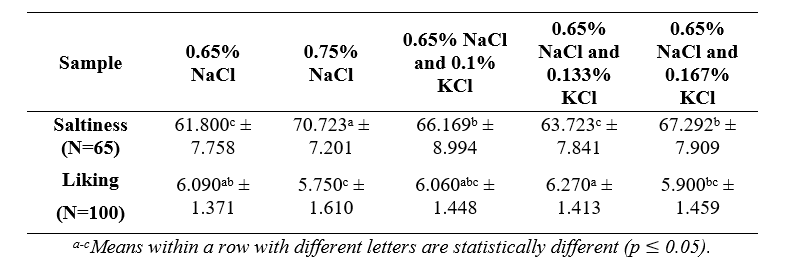
Salt (NaCl) reduction is currently a critical problem. High salt consumption leads to the excessive amount of Na+ in bloodstream, which negatively affects human health by increasing the risks of getting hypertension, cardiovascular and other diseases. Among the prospective substances for replacing NaCl, potassium chloride (KCl) is one of the most promising one. However, KCl at high concentration was reported to impart the metallic taste and bitterness in food, so research on the optimal replacement of NaCl by KCl is an ongoing endeavour. This research was therefore conducted to investigate the effect of replacing NaCl by KCl on the saltiness perception and the acceptance level in two soups: Vietnamese pumpkin soup and tomato soup. The visual analog scale (VAS) was used to measure the saltiness perception, while the hedonic 9 – point scale was used to evaluate the customer’s acceptance level. Each soup was prepared with 5 different combinations of KCl and NaCl: 2 NaCl samples with no KCl added (0.65% and 0.75%), 3 samples with the NaCl concentration remained at 0.65% and different levels of KCl (0.1%, 0.133%, and 0.167%). Overall, all three samples with KCl added had higher salty intensity than the 0.65% NaCl, but these samples’ saltiness did not reach that of sample with 0.75% NaCl in both Vietnamese pumpkin soup and tomato soup. For the hedonic scores, the results showed that adding KCl did not have significant effects on the acceptance of the consumers, since there were no significantly differences between those samples in both soups. It can be concluded that KCl, at the concentration in this research, effectively enhance the saltiness in Vietnamese pumpkin soup and tomato soup without leaving any undesirable sensory properties that affected the consumers. Therefore, KCl can be considered as a good solution in reducing NaCl.