


Joint radar and communication system: Pre-processing method with OFDM Radar waveform
- School of Electrical Engineering, International University, 700000 Ho Chi Minh City, Vietnam
- Vietnam National University, 700000 Ho Chi Minh City, Vietnam
Abstract
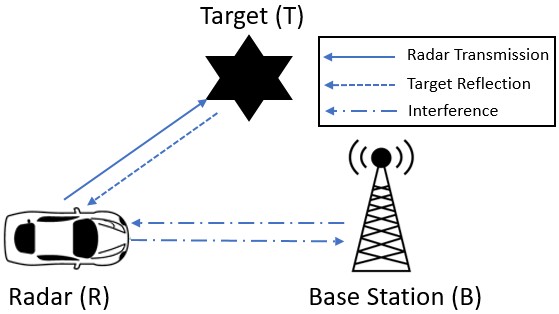
In this paper, we investigate a Joint Radar and Communication (JRC) system that utilizes a standard orthogonal frequency division multiplexing (OFDM) signal to enable efficient spectrum sharing. The increasing demand for spectrum efficiency has driven the development of JRC systems, which allow simultaneous sensing and data transmission while maintaining reliable communication. However, spectrum resource allocation remains challenging due to interference between radar and communication signals, which may degrade target detection performance and communication reliability. Therefore, spectrum management and interference mitigation are essential for improving JRC performance. To address this issue, we propose an OFDM packet structure that enhances detection accuracy, along with a pattern matrix that optimizes spectrum allocation to prevent interference. The proposed packet structure enables radar and communication functions to share the spectrum more efficiently while maintaining compatibility with conventional OFDM signaling. In addition, the proposed pattern matrix provides a mechanism for allocating spectrum resources, thereby reducing the overlap between radar and communication transmissions and improving sensing robustness. The proposed framework enhances spectrum utilization without introducing significant changes to the standard OFDM waveform. Simulation results demonstrate the impact of the proposed method on radar performance under various detection algorithms, including Two-Dimensional Fast Fourier Transform, Multiple Signal Classification, and Estimation of Signal Parameters via Rotational Invariance Techniques. Performance comparisons show that the proposed packet structure and spectrum allocation strategy improve target detection capability while effectively suppressing interference. The results further confirm that, at the Radar node, target detection can be enhanced and interference reduced, making the proposed approach well-suited for JRC applications in dynamic wireless environments. These findings indicate that the proposed method provides a practical solution for improving sensing performance while preserving reliable communication in future spectrum-sharing JRC systems.