


Preparation of ZSM-5/TiO2 photocatalyst by dip-coating method and evaluation isopropanol removal capacity
- Ho Chi Minh City University of Technology
- Vietnam National University Ho Chi Minh City
Abstract
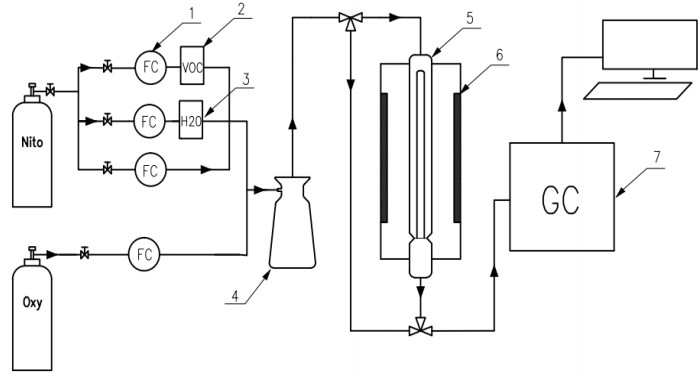
The incorporation of TiO2 with zeolite ZSM-5 has been explored to facilitate photocatalytic activity and establish a continuous volatile organic compound (VOC) treatment system. In this study, composites of ZSM-5 and commercial TiO2 with various ratios were successfully deposited onto cylindrical glass tubes by the dip-coating method using specialized equipment. To improve suspension stability and mitigate the sedimentation of heavy particles, a carboxymethyl cellulose additive was introduced into the mixture. The morphology properties and component determination were characterized with SEM-EDX, revealing the homogeneous distribution after applying the dip-coating method, showing a minor deviation of only 4% to 12% between actual and theoretical mass loadings. Photocatalytic performance was evaluated through the removal of gaseous isopropanol (IPA) utilizing an air simulation system coupled with gas chromatography (GC-FID) analysis. A wide range of factors, including humidity, concentration of VOC, UV light intensity, and the catalyst's mass, were simulated to investigate their effect on the photocatalyst’s performance and make a conclusion in the most optimal working condition. Gas chromatography (GC) analysis of VOC content after treatment asserts the superiority of materials containing ZSM-5 and TiO2 at appropriate ratios (2:8 and 6:4) over TiO2 solely, with higher photocatalytic efficiency (47.7% and 42.9%). The higher the humidity and VOC concentrations, the lower the productivity of the photocatalyst. Furthermore, long-term activity testing demonstrated the excellent structural stability and durability of the optimized composite, which maintained a consistent conversion efficiency of approximately 46% over 6 consecutive hours of continuous operation. Interestingly, doubling the deposited catalyst mass from 0.1 g to 0.2 g yielded no significant increase in photocatalytic efficiency, indicating that performance is primarily governed by the component ratios exposed directly to light rather than total coating mass. Quantitatively, increasing the UV intensity from 2 to 4 lamps significantly accelerated hydroxyl radical generation and doubled the maximum treatment efficiency. Therefore, the most optimal condition and catalyst preparation process should be surveyed for the effectiveness of VOC gas treatment.