


Experimental study on the time-dependent changes in the mechanical and physical properties of sea sand seawater concrete
- Ho Chi Minh City University of Technology
- Vietnam National University Ho Chi Minh City
- Tay Do University
- Ton Duc Thang University
Abstract
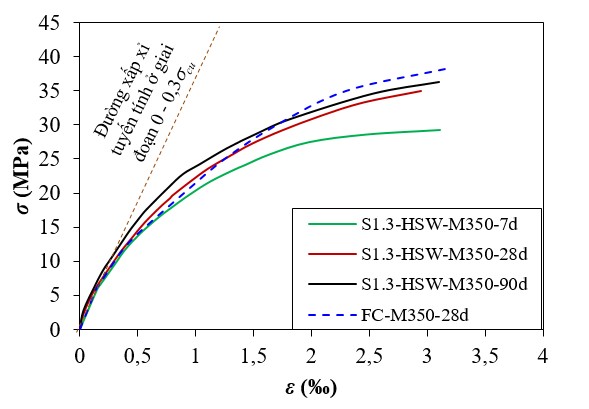
This paper presents an experimental study on the time-dependent changes in certain mechanical and physical properties of seawater sea sand concrete, compared with those of fresh water river-sand concrete. The investigated properties include compressive strength, splitting tensile strength, elastic modulus, and shrinkage strain, based on an experimental tests conducted on 123 specimens. The results show that the compressive and splitting tensile strengths of seawater sea sand concrete tend to develop more rapidly than those of fresh water river-sand at 7 days, but subsequently slow down and become lower than those of fresh water river-sand between 28 and 180 days. Increasing the sand fineness modulus (from 1.3 to 1.6) and variations in seawater salinity (0,78% và 2,34%) have a negligible effect on the compressive strength of the concrete. At 28 days, the elastic modulus of seawater sea sand concrete is slightly higher (approximately 6.9%) than that of fresh water river-sand. Concrete shrinkage strain increases rapidly from day 3 to day 21 and then gradually slows down. The shrinkage strain of seawater sea sand concrete does not differ significantly from that of fresh water river-sand, although it is lower during the 3 to 21 - day period and higher during the 21 to 70 - day period.