

Green Buildings in Vietnam: Development Process, Global Principles, and Future Trends
- Faculty of Civil Engineering, Ho Chi Minh City University of Technology
- Vietnam National University Ho Chi Minh City
Abstract
Vietnam ranks as one of the most climate-affected countries globally, prompting an urgent need for sustainable development within its highly impactful construction sector. Since the mid-2000s, Vietnam has been advancing its green building movement, significantly marked by the establishment of the Vietnam Green Building Council in 2007. While the adoption of green building practices initially lagged behind regional peers like Singapore, recent years have witnessed rapid sector expansion. By 2023, the market experienced a significant surge, with certifications more than doubling from the previous year, driven by increasing market demand, multinational sustainability mandates, and international frameworks such as the European Union’s Carbon Border Adjustment Mechanism. Currently, four primary rating systems: LEED, LOTUS, EDGE, and Green Mark, dominate the Vietnamese market, covering nearly two million square meters of certified gross floor area.
Despite this promising momentum, significant progress is still required to meet both national targets and global commitments, including the climate pledge Vietnam announced at COP26. The transition of green building from a voluntary choice to a "market necessity" is heavily constrained by institutional and financial bottlenecks, such as a shortage of trained experts, perceived high upfront investment costs, and market confusion surrounding the various coexisting certification systems.
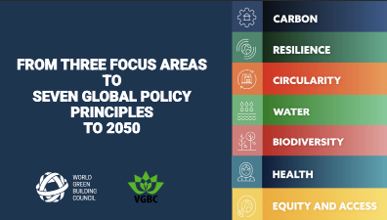
To navigate these challenges, this paper explores the green building landscape in Vietnam during the 2020s and systematically aligns it with the World Green Building Council’s seven global policy principles for 2050: Carbon, Resilience, Circularity, Water, Biodiversity, Health, and Equity. Given Vietnam's high vulnerability to climate change, the study emphasizes that principles centered on "Resilience" and "Water" conservation are particularly fundamental for local urban planning. Ultimately, thiss principles-based framework serves as a strategic roadmap to help stakeholders make informed investment decisions and accelerate the transition toward a resilient, net-zero built environment.