


Study on Landslide Mechanism on Basaltic Soils in Lam Dong Province, Vietnam
- Faculty of Geology & Petroleum Engineering, Ho Chi Minh City University of Technology (HCMUT) - Vietnam National University Ho Chi Minh City, Linh Xuan Ward, Ho Chi Minh City, Vietnam
- Bach Khoa Ho Chi Minh City Science Technology Joint Stock Company, Ho Chi Minh City University of Technology, VNU-HCMC
Abstract
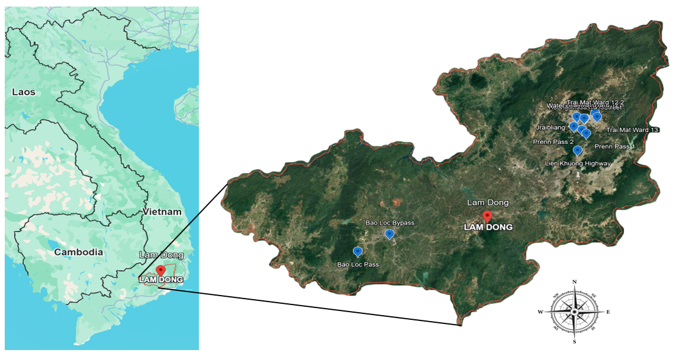
This study investigated the key physical and chemical properties of basaltic soils in Lam Dong Province, Vietnam, and assessed their influence on slope stability under the region's distinct tropical monsoon climate. The integrated research methodology combined comprehensive field surveys, sampling across representative slopes with detailed laboratory analyses and numerical modeling. A total of 90 soil samples were collected and subjected to a series of tests to determine critical physical and mechanical parameters, including natural moisture content, Atterberg limits (liquid limit, plastic limit, and plasticity index), specific gravity, and grain size distribution. The stability of representative slopes was then simulated under varying rainfall infiltration scenarios using the finite element method in Plaxis 2D software. The experimental results revealed that the soils are characterized by a significant clay fraction (≥ 30%), with the presence of expansive montmorillonite group minerals. This mineralogical composition promotes pronounced shrink-swell cycles in response to seasonal moisture variations, generating cracks and fissures that facilitate deeper water infiltration. The modeling and analysis further demonstrated that prolonged and intense monsoon rainfall critically reduces soil shear strength by markedly increasing pore water pressure and decreasing effective stress within the soil matrix. Concurrently, the chemical weathering process, particularly the dissolution and alteration of iron oxide (Fe₂O₃) cementing agents under the influence of naturally acidic rainwater, contributes to the long-term weakening of soil structure and further slope destabilization. Moreover, the slope stability modeling conclusively quantified the detrimental impact of rainfall, showing a significant reduction in the factor of safety for slopes during simulated events. This research elucidates the coupled hydro-mechanical and chemical mechanisms driving landslides in this setting, where intense weathering, high clay content, and monsoon hydrology interact. The findings substantially deepen the understanding of failure mechanisms in tropical red basaltic soils. Consequently, they provide a scientific basis for selecting and designing appropriate slope stabilization, drainage, and land-use planning interventions. This work is pivotal for developing integrated geotechnical and hydrological management strategies to mitigate landslide risks not only in Lam Dong Province but also across similar terrains in the Central Highlands of Vietnam, thereby contributing to enhanced resilience and natural disaster prevention.