


Stability of Li4SnS4 towards water molecules and its application in the preparation of sulfide-based solid electrolytes
- Faculty of Applied Science, Ho Chi Minh City University of Technology, 268 Ly Thuong Kiet, Dien Hong Ward, Ho Chi Minh City
- Ho Chi Minh City National University, Truong Tho Ward, Ho Chi Minh City
- Faculty of Materials Technology, Ho Chi Minh City University of Technology, 268 Ly Thuong Kiet, Dien Hong Ward, Ho Chi Minh City
- National Key Laboratory of Polymer and Composite Materials, Ho Chi Minh City University of Technology, 268 Ly Thuong Kiet, Dien Hong Ward, Ho Chi Minh City
Abstract
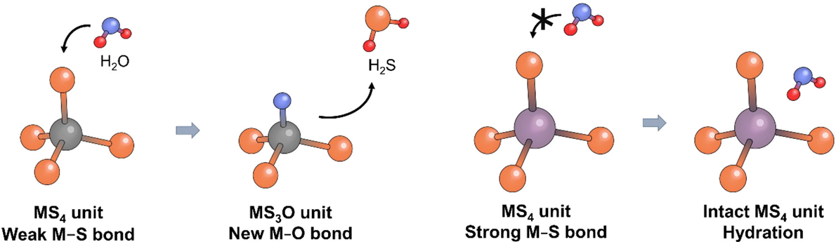
Solid-state batteries are considered as the next generation of energy storage devices because they have higher potential energy density and better safety than commercial lithium-ion batteries based on organic liquid electrolytes. However, solid-state electrolytes still have many problems to solve before they can be brought to the market. Most solid-state electrolytes are sensitive to air, resulting in complex and expensive cell assembly and vulnerable interfaces. Therefore, solid-state electrolytes are expected to be stable in the atmosphere, which will certainly bring significant benefits to the production of solid-state batteries. This review focuses on Li4SnS4, a sulfide electrolyte that is stable in moist air and soluble in water. The reactions between Li4SnS4 and H2O and CO2 molecules will be analyzed. Based on the understanding of the hydrolysis reaction of Li4SnS4, we summarize the solid electrolytes that are stabilized in air by using Li4SnS4 in their chemical composition. The HSAB theory indicates that the weak bonding between hard acid cations (e.g., P5+) and soft base anions (S2-) in sulfides exacerbates the tendency towards hydrolysis. Introducing softer acid cations (e.g., Sn4+, Sb5+) enhances the stability of the internal structural units. Furthermore, optimizing conventional synthesis processes or developing novel synthesis methods significantly reduces material porosity and increases density, thus improving the intrinsic structural stability of SE crystals. However, even very small levels of CO2 can initiate hydrolysis in sulfite-grouped SEs, which has significant implications for material handling and device fabrication under atmospheric conditions.