


A Design of a bender element-based device for measuring shear wave velocity in sand embankments
- Faculty of Civil Engineering, HUTECH University, 475A Dien Bien Phu Street, Thanh My Tay Ward, Ho Chi Minh City, Vietnam
- Faculty of Mechanical Engineering, Ho Chi Minh City University of Technology and Engineering, 01 Va Van Ngan Street, Thu Duc Ward, Ho Chi Minh City, Vietnam
- Faculty of Civil Engineering, Van Lang School of Technology, Van Lang School of Technology, Van Lang University, 69/68 Dang Thuy Tram Street, Binh Loi Trung Ward, Ho Chi Minh City, Vietnam
Abstract
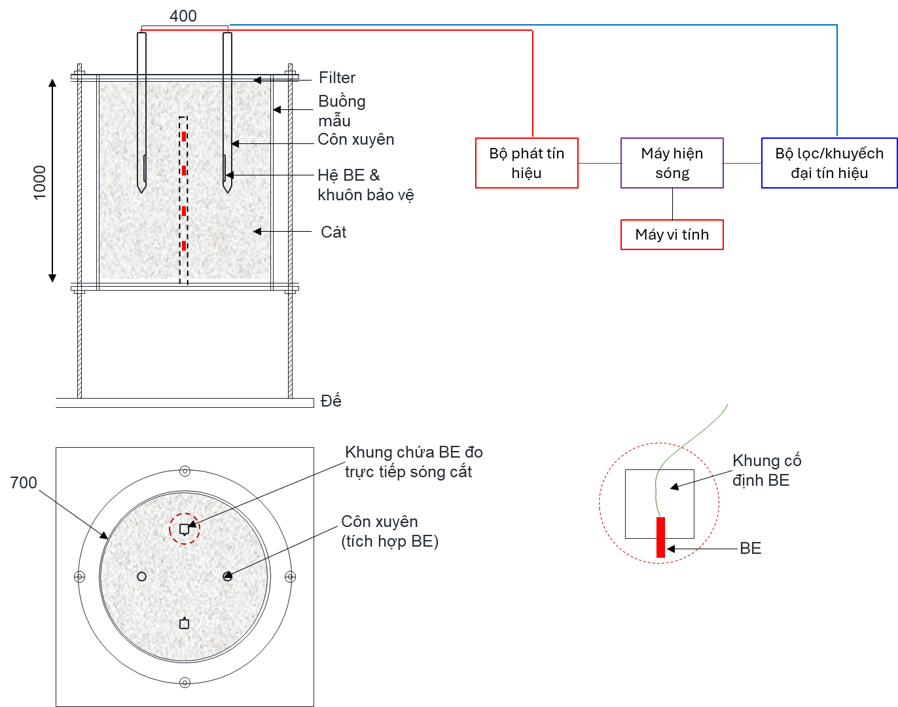
The maximum shear modulus (Gmax), calculated from shear wave velocity (Vs) and soil density, is an important geotechnical parameter for evaluating the mechanical behavior of soils at very small shear strains. It plays an important role in the design of foundations subjected to dynamic loading, monitoring changes in ground conditions, assessing liquefaction potential, and evaluating ground improvement performance. This study presents a detailed design of a mobile device for direct measurement of shear waves in compacted soil embankments. The proposed system consists of a dual-cone penetration configuration equipped with integrated bender elements (BE) acting as both wave transmitters and receivers to determine the shear wave velocity (Vs). The bender elements are housed within protective casings and can be extended or retracted during testing. Key design considerations include minimizing soil disturbance during penetration, protecting and deploying the sensors effectively, enhancing soil–sensor interaction, and reducing electromagnetic and frame-wave interference. The proposed device is intended to overcome several limitations of existing field shear-wave measurement techniques, including localized measurement coverage, potential sensor damage during penetration, and signal degradation caused by wave interference. In addition to determining shear wave velocity, the system has the potential to support the assessment of soil uniformity and anisotropy in compacted sand embankments through the analysis of wave signals collected at different measurement locations. A calibration framework is also proposed, in which the shear wave velocity measured by the device is compared with reference values obtained from embedded bender element systems under controlled laboratory conditions. This framework provides a basis for evaluating measurement errors and guiding future calibration and improvement of the device. The proposed design demonstrates potential for in-situ evaluation of shear wave velocity in sand embankments, supporting compaction control, dynamic soil characterization, and infrastructure monitoring. Further experimental studies and field implementation are required to validate and refine the proposed system.