


Experimental research on the drying process of Pisum Sativum on the Heat Pump combined with a Rotary Drum dryer.
- Department of Heat and Refrigeration, Faculty of Mechanical Engineering, Ho Chi Minh City University of Technology (HCMUT), Ho Chi Minh City, Vietnam
- Vietnam National University Ho Chi Minh City, Ho Chi Minh City, Vietnam
- Faculty of Heat and Refrigeration Technology, Cao Thang Technical College, Vietnam
Abstract
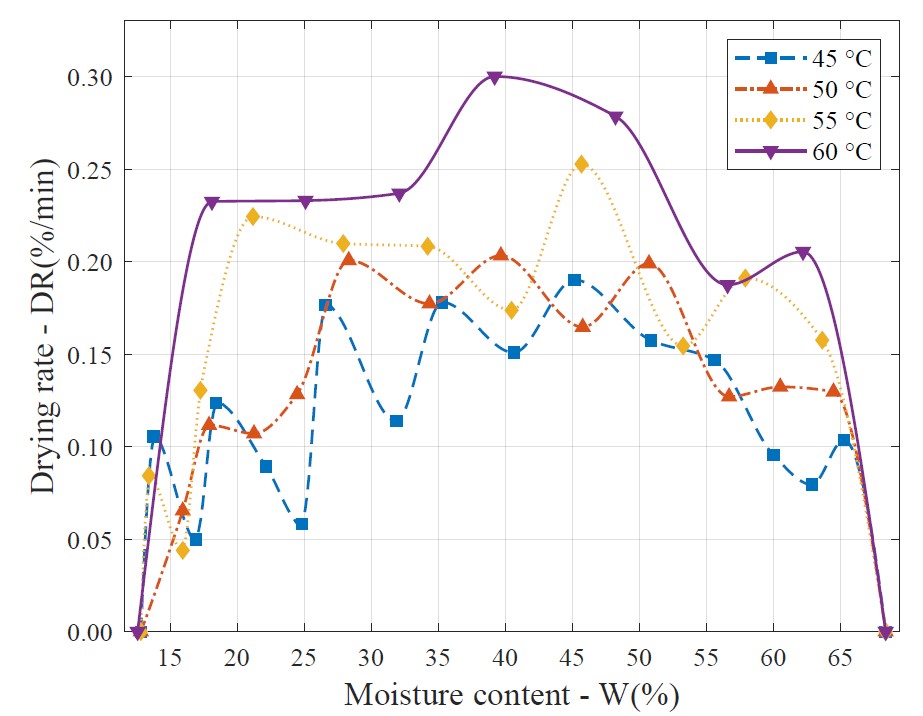
A study on a combined heat pump and rotary drum drying system was conducted to evaluate the drying process on pea products. The experiment examined the effects of drying temperature, air speed, and drum speed on drying kinetics and product color deviation. In addition, the drying results between two types of dryers, a combined heat pump and rotary drum dryer, and a conventional heat pump dryer with full reflux, as well as the compatibility analysis of mathematical models, were also analyzed. The results showed that at drying temperatures of 45-60 °C, drying time was significantly reduced, and the quality of the dried product, assessed by color analysis at 45-55 °C, was comparable. By contrast, at 60 °C, although the time was reduced by nearly half compared with 45 °C, the quality changed significantly; the color deviation reached 23, compared with 13.78 when drying at 50 °C. When wind speed increases from 1.5 m/s to 3 m/s, the drying process becomes unstable in the too-weak-wind mode at 1.5 m/s, resulting in longer drying time and greater deviation. Regarding the influence of drum speed on the drying process, the experiment was conducted in the range of 4-14 rpm. The results were remarkable: the higher the speed, the faster the product dried. However, the optimal color deviation results at 8 rpm and 10 rpm were 10.69 and 13.97, respectively. Based on the experimental results, the optimal drying conditions were 50 °C drying temperature, 2.5 m/s wind speed, and 8 rpm drum speed. Another notable result is that, when comparing the drying process of the product on the two drying systems, drying on the combined heat pump and rotary drum system is 10-30% more efficient than the traditional heat pump in terms of time savings. Finally, when analyzing the mathematical model for drying peas on the rotary drum heat pump drying system, Midilli's model yields results consistent with the experimental data across all modes.