


A novel approach combining isogeometric analysis and the moving element method for the analysis of ultra-long beams under moving loads
- Faculty of Civil Engineering, Ho Chi Minh City University of Technology (HCMUT), 268 Ly Thuong Kiet Street, Dien Hong Ward, Ho Chi Minh City, Vietnam
- Vietnam National University Ho Chi Minh City (VNU-HCM), Linh Xuan Ward, Ho Chi Minh City, Vietnam
Abstract
This paper presents a novel numerical approach that combines isogeometric analysis and the moving element method, referred to herein as moving isogeometric analysis, for the dynamic analysis of ultra-long composite beams subjected to moving loads on viscoelastic foundations. In the proposed formulation, the moving coordinate system of the moving element method is integrated with the NURBS-based functions of the isogeometric analysis, enabling exact geometric representation while significantly improving computational efficiency for large-span structural problems. To accurately capture the mechanical behavior of composite materials and the effects of transverse shear deformation, a higher-order shear deformation theory is employed. The use of NURBS basis functions not only eliminates geometric approximation errors but also naturally satisfies the higher-order continuity requirements of the higher-order shear deformation theory, thereby enhancing the accuracy and numerical stability of the proposed model.
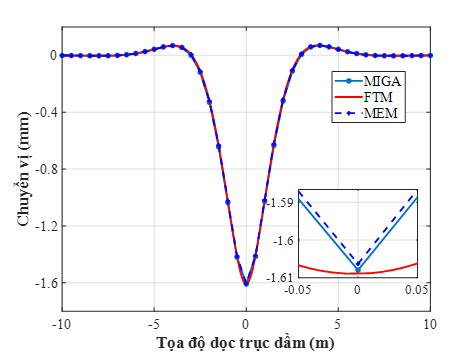
The reliability and effectiveness of the moving isogeometric analysis approach are validated through several numerical examples and comparisons with analytical solutions as well as previously published results. The obtained results demonstrate that the proposed method achieves excellent agreement with three-dimensional elasticity solutions in static analysis. In dynamic analysis, the moving isogeometric analysis provides results that closely match the reference solutions while requiring less computational time than the conventional moving element method and yielding higher accuracy compared with the Fourier transform method. Finally, the influences of viscoelastic foundation parameters and moving load velocity on the dynamic responses of composite beams are systematically investigated and discussed in detail.