


Analytical approach for determining shear strength and failure modes of DE-FRP-retrofitted RC beams
- Faculty of Civil Engineering, Ho Chi Minh City University of Technology (HCMUT), 268 Ly Thuong Kiet Street, Dien Hong Ward, Ho Chi Minh City, Vietnam
- Vietnam National University Ho Chi Minh City, Linh Xuan Ward, Ho Chi Minh City, Vietnam
Abstract
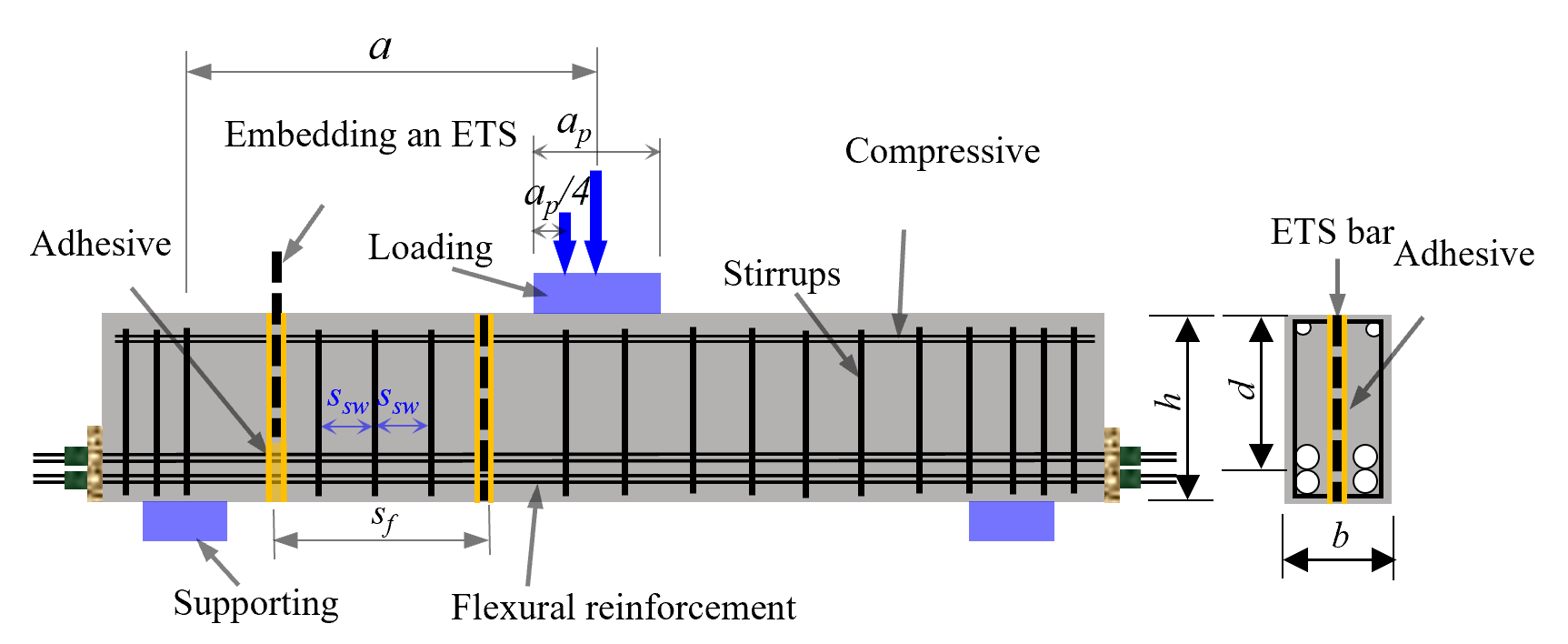
Fiber-reinforced polymer (FRP) composites have been widely used to enhance and rehabilitate reinforced concrete (RC) members subjected to shear, flexural, and axial actions due to their high strength-to-weight ratio and corrosion resistance. Among the available strengthening techniques, the embedded through-section (ETS), also referred to as the deep embedment (DE) method, has recently emerged as a highly effective solution for shear strengthening of RC beams. Experimental studies have demonstrated that ETS-strengthened beams can achieve substantially greater shear enhancement than conventional externally bonded (EB) and near-surface mounted (NSM) systems, in which FRP composites are attached to or embedded near the concrete surface. The superior performance of the ETS technique is mainly attributed to its improved anchorage and more efficient interaction with the internal shear resisting mechanisms of RC beams. This paper presents an analytical approach to evaluate the failure mechanism and shear strength of RC beams retrofitted with ETS-FRP bars. First, the shear tension-controlled capacity model previously developed by the authors is enhanced by incorporating the interaction among the shear resistances of concrete, ordinary transverse steels, and ETS-FRP bars through the effective transverse strain of the strengthening system. Three formulations for estimating the effective transverse strain of the FRP strengthening are examined. The previously developed formulations for shear compression-controlled capacity are then integrated with the enhanced model to evaluate shear behavior through variations in the major shear crack angle and the resulting shear strength. Experimental and numerical data on ETS-FRP-retrofitted beams from past works are utilized to corroborate the enhanced approach. The corroboration results show good agreement, with an average tested-to-predicted shear strength ratio of approximately 0.8 and a coefficient of variation below 20%, demonstrating the reliability of the proposed method.