


One-step structural damage detection in spatial frames using modal strain energy and 1D-CNN
- Faculty of Civil Engineering, Ho Chi Minh City University of Technology (HCMUT), Ho Chi Minh City, Vietnam
- Vietnam National University Ho Chi Minh City, Ho Chi Minh City, Vietnam
- Faculty of Civil Engineering, Nha Trang University, Khanh Hoa Province, Vietnam
- Faculty of Engineering Technology, Tien Giang University, Dong Thap Province, Vietnam
Abstract
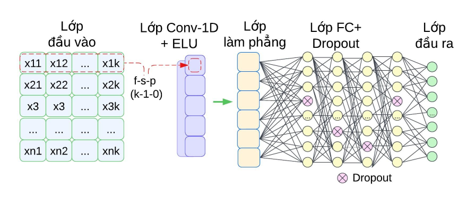
Structural health monitoring plays a crucial role in the early detection of structural damage, ensuring operational safety, and supporting structural maintenance. However, current vibration-based damage identification methods have relied on a two-step procedure, including damage localization and damage severity quantification, which may increase computational cost. This paper proposes a one-step damage identification procedure that simultaneously determines the location and severity of element-level damage in a three-dimensional frame structure, using strain energy features and a one-dimensional convolutional neural network (1D-CNN). The input data are constructed from element strain energy, which is calculated from mode shapes obtained through numerical simulation. The 1D-CNN model is used to extract features and predict the damage state of structural elements. To evaluate the proposed procedure, a three-dimensional steel frame consisting of 52 elements is investigated with two input data cases: using six mode shapes and using the first two mode shapes. The training results show that the model achieves good prediction performance, with average R² values of 99% for the training set and 98% for the testing set. In addition, through the assessment of damage identification errors for 250 damage cases involving one to five damaged elements, the proposed procedure demonstrates its ability to accurately identify damage locations, with the average error in predicting damage severity ranging from 1% to 5%. The identification results show that using only the first two mode shapes provides results nearly equivalent to those obtained with six mode shapes, thereby demonstrating the feasibility of the proposed procedure for practical implementation.