


Real-time simulation of fluid flow in porous media using the self-organized gradient percolation method
- Faculty of Applied Science, Ho Chi Minh University of Technology (HCMUT), VNU-HCM, Ho Chi Minh city, Vietnam
Abstract
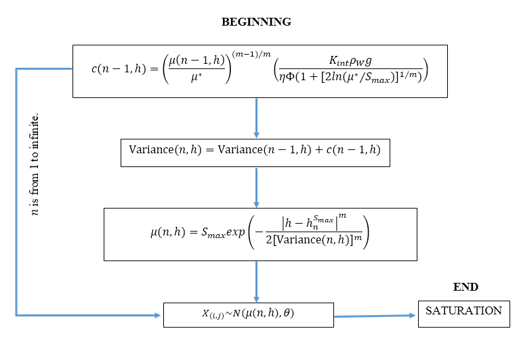
A significant reduction in the computaional time of simulations of fluid flow in porous media is showed using the (one-dimensional) Self-organised Gradient Percolation (SGP) method. The SGP method is often used for the simulations at numerical timestep instead of real time, thereby limiting comparing with benchmark from other methods (e.g., finite element methods). The aim of the current study is to convert the numerical timestep into the real time of simulations of the SGP method. In particuar, by describing the change in time of variance in the probability density function of the SGP as an ordinary differential equation. The temporal evolution of the liquid front z in a porous sample at timestep t (it is denoted by dz/dt) is described as the time-dependent capillary rise using Poiseuille’s equation. The Newton’s method is then applied to interrelate the numerical timestep with the real-time of simulations with the chosen initial timestep. The SGP algorithm (from our previous study) is updated these points to simulate the model outcomes at real-time. Hence, in the current study, for the correctness of the SGP algorithm, we apply the SGP model to the two case studies (with the same porous sample, but with two diferent liquids). The numerical outcomes from the SGP model are inferred at the real simulation time corresponding to specific time steps. Then, these predictions at these inferred real times from the SGP model are compared with those obtained using conventional numerical methods, in which the mass balance equation is solved with the van Genuchten and Brooks–Corey models to describe the capillary pressure curve. We present the development of self-organization gradient percolation model, considered in the case of non-reactive impregnation permits to provide simulations in real time with a reduction of the computational time by a factor of 100 (as expected from our previous study).