


Optimizing the placement of a number of D-Statcom for improving SARFIX in the distribution system
- School of Electrical Engineering, Hanoi University of Science and Technology, Hanoi, Viet Nam
Abstract
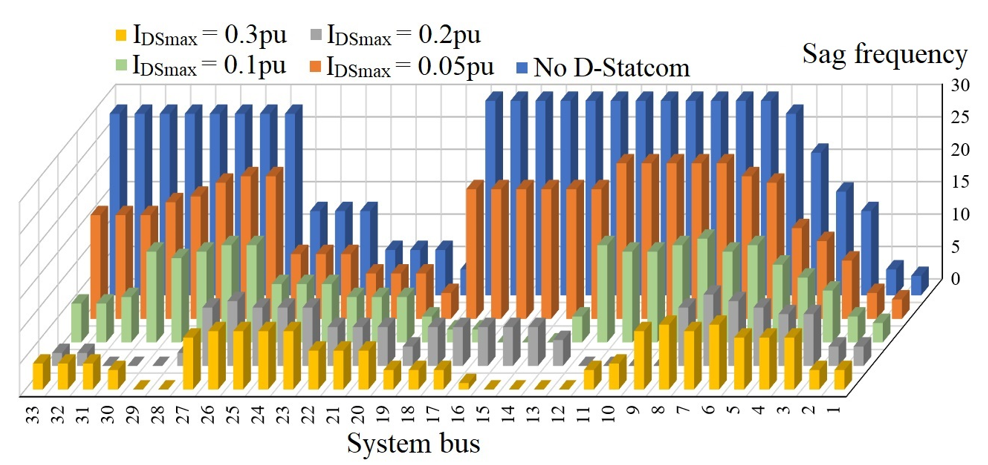
While the users only consider solutions for power quality improvement at a single site, utilities concern about solutions for power quality improvement for not only an individual location, but also for the whole system. Therefore, the paper deals with an utilities' systematic solution for power quality mitigation by using simultaneously a number of custom power devices in distribution system. In the paper, a new method is introduced for optimizing the placement of a multiple of Distribution Synchronous Compensation Devices - D-Statcoms for globally mitigating the voltage sags due to faults in distribution systems according to the ``central improvement'' approach. D-Statcom's placement is optimally selected in a distribution system basing on a problem of optimization where the objective function is to minimize the system average rms voltage variation frequency index – SARFIx of the system of interest. The effectiveness for global voltage sag mitigation in a distribution system by the presence of a number of D-Statcoms is newly modeled basing on the method of Thevenin's superimposition in the problem of short-circuit calculation in the distribution system. The presence of D-Statcoms is simulated as the matrix of additionally injected currents to buses for increasing the voltage of all buses throughout the system of interest. The paper considers the case of using a multiple of D-Statcoms with a proposed voltage compensating principle that can be practical for large-size distribution systems. In the paper, the IEEE 33-buses distribution feeder is used as the test system for global voltage sag simulation in the events of short-circuit in the system and various influential parameters to the outcomes of the problem of optimization such as rms voltage threshold and D-Statcom's limited current are considered and discussed.