


An Novel Approach to Improve the PF and Reduce THD for Two-stage LED Driver
- Ho Chi Minh City University of Technology, VNU-HCM
Abstract
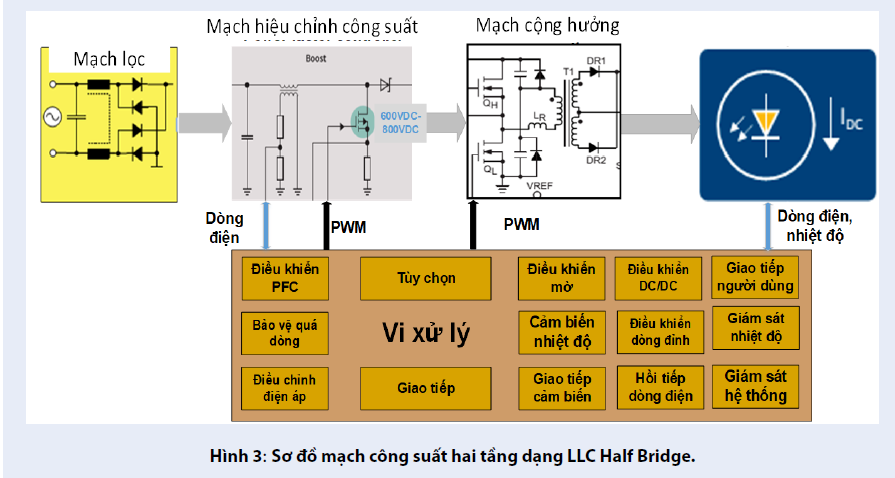
Nowadays, the incadescent, florescent, and high-pressure mercury lamps was replaced by the LED (Light-Emitting-diode) …due to the high efficiency, enviromenttally friendly and long life-time. This paper presents an analysis and experimentation on 250W LED Driver with high power factor and improving the toral harmonic distortion. The presented topology in this paper is designed based on two-stage LED Driver which is included: the boost power factor correction circuit operating in discontinuous mode and an isolated DC/DC LLC resonant circuit with soft-switching characteristics. The function of the boost power factor correction stage is to ensure the high input power factor and to generate 400VDC from variable AC power supply: 140VAC to 260VAC. The target of the DC/DC stage is to control the DC current for supplying LED load. The guideline for design is in detail described. A LED Driver prototype was built in laboratory for supplying 250W/54V from single phase AC power supply 220V/50Hz. The experimental results are shown to verify the performance of the LED Driver comply with the EN 61000-3-2 standard.