


BLE-based Indoor Positioning System for Hospitals using MiRingLA Algorithm
- Ho Chi Minh City University of Technology - VNU-HCM
Abstract
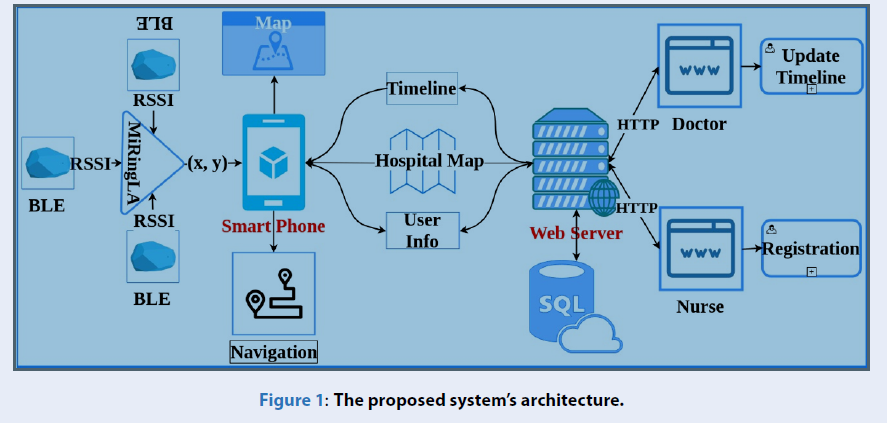
Over the past decades, locating and navigating to the departments and wards in a large hospital have never ceased to draw public attention. A large number of human-based efforts and solutions have been given to deal with the difficulty in location and navigation in a large hospital. However, the problem is still existing, which urges human to take technology into account seriously. In this context, an indoor positioning system comes into play, it can not only tackle the trouble but also act as a prospective platform to build other applications on top of it. Nonetheless, the ever-changing environment and the heavy dependence on installation stage have precluded many state-of-theart methodologies from practice. In this paper, we present an indoor positioning system based on Bluetooth Low Energy and applied to hospitals, which is easy-deployed, robust in the noise-rich, obstacle-rich environment. The system provides 3 principal functions like new medical examination registration, patient's in-app schedule management, and navigation. We implemented a web application to realize the first function. Besides, an Android application was developed to put ability up for patients to manage schedules and find ways. Moreover, we proposed a positioning method that is a modification to inter Ring Localization Algorithm (iRingLA), called MiRingLA. It utilizes 3 rings and Least Squares Estimation to deal with the drawback of the iRingLA. In addition, we applied a Kalman filter to reduce noises from received signals. The proposed method was experimented in a practical environment and achieved the mean localization accuracy of 0.91 m. Moreover, we performed comparisons between our proposed method and some of the others. Our proposed scenarios were experimented and proved to be feasible and suitable for a real application.