


Applying improved Backward/Forward method in optimizing power distribution connected DG
- HCMC University of Technology and Education, Ho Chi Minh City
- Vietnam National University, Ho Chi Minh City
Abstract
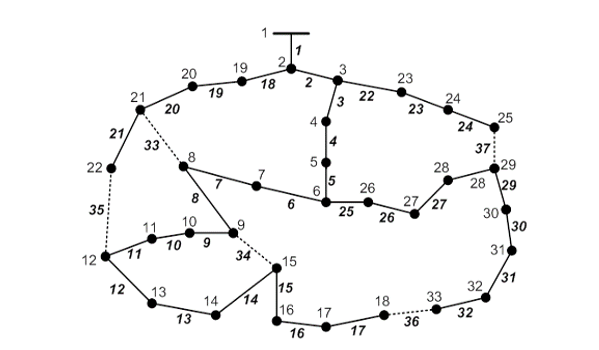
In recent years, there is robust development of distributed generations (DG) connected into the electrical system. Thus, The issues such as the optimization problem of the position and capacity of power distribution sources has taken into account the re-configuration on the electricity distribution system to minimize the total Power loss on the ray distribution grid as well as minimizing the total calculation time which is an essential requirement. This paper proposes enhancement Backward/Forward method which is change for Newton - Graphson and Gauss - Seidel methods are being used. We used PSO optimization algorithm accompanied by power distribution calculation tool which is Backward/Forward method to calculate the power distribution in the optimsize location and capacitance of Distributed Generations considering the re-configuration of the electrolytic grid. The algorithm has been simulated on three IEEE ray power distribution systems which includes 3 types of power grids: 33-node power distribution system, 69 nodes and 119 nodes. Simulation result presents that our proposal improves the performance of distribution grid system and better than some other algorithms.