


A probability-based artificial potential field for autonomous vehicles in avoiding uncertain obstacles
- Faculty of Electric-Electronics Engineering (FEEE), Ho Chi Minh City University of Technology (HCMUT), 268 Ly Thuong Kiet Street, District 10, Ho Chi Minh City, Viet Nam
- Vietnam National University Ho Chi Minh City (VNU-HCM), Linh Trung Ward, Thu Duc City, Ho Chi Minh City, Viet Nam
Abstract
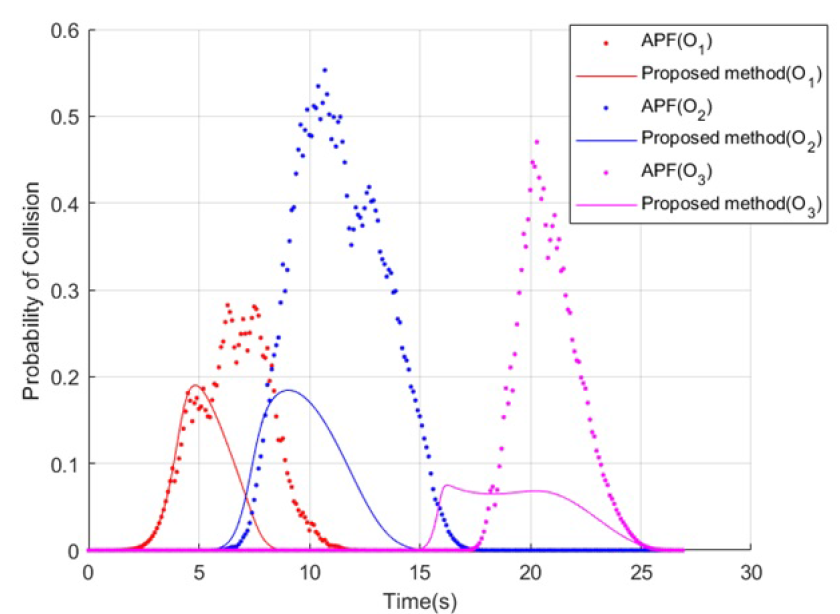
Nowadays unmanned vehicles are compulsorily required to contain a reliable collision avoidance system as to reach closer toward the target of the autonomous vehicle (AV). Up to now lots of obstacle avoidance techniques have been introduced and successfully applied in practice. Unfortunately, in almost of these ob-stacle avoidance algorithms, the uncertainty of the input that includes obstacle tracking measurements, have not been satisfactorily investigated. This uncertainty happened from measurement approaches along with obstacles’ nonlinear locomotion. Several researches have tried to overcome this problem via detecting obsta-cles directly or indirectly based on global/local communication and/or the third party like the Automatic identification system (AIS). Inspired with these achievements, this paper aims to deal with uncertain infor-mation of obstacles resulting in from practical obstacle-avoiding techniques for autonomous vehicles. In fact, this problem is ignored in many researches by assumptions that measurements are perfect or the vehicle can fully observe the state of obstacles. A probability model is proposed to evaluate the possibility of colli-sion quantitatively based on the current position of the vehicle and the probability distribution of obstacles’ position. This probability model is then applied to design a new repulsive function. Hence, the resulting arti-ficial potential field can avoid uncertain obstacles by maneuvering the vehicle in the direction of decreasing collision risk. Numerical simulations are carried out to verify the proposed collision avoidance model, and the simulation results show that the proposed method can help autonomous vehicles to efficiently pass obsta-cles safely with uncertain information. As a consequent, the proposed algorithm can guide the autonomous vehicle (AV) to effectively and safely pass static and dynamic obstacles with respect to uncertain infor-mation. Further research can focus on dynamic obstacles which will be investigated via integrating the speed variable into the considered probability model.