


Decentralized space vector pulse width modulation method for multilevel single-phase half bridge converters
- Ho Chi Minh City University of Technology, VNU-HCM, Ho Chi Minh City University of Food Industry (HUFI)
- Ho Chi Minh City University of Technology - VNU-HCM
- Ho Chi Minh City University of Technology, VNU-HCM
Abstract
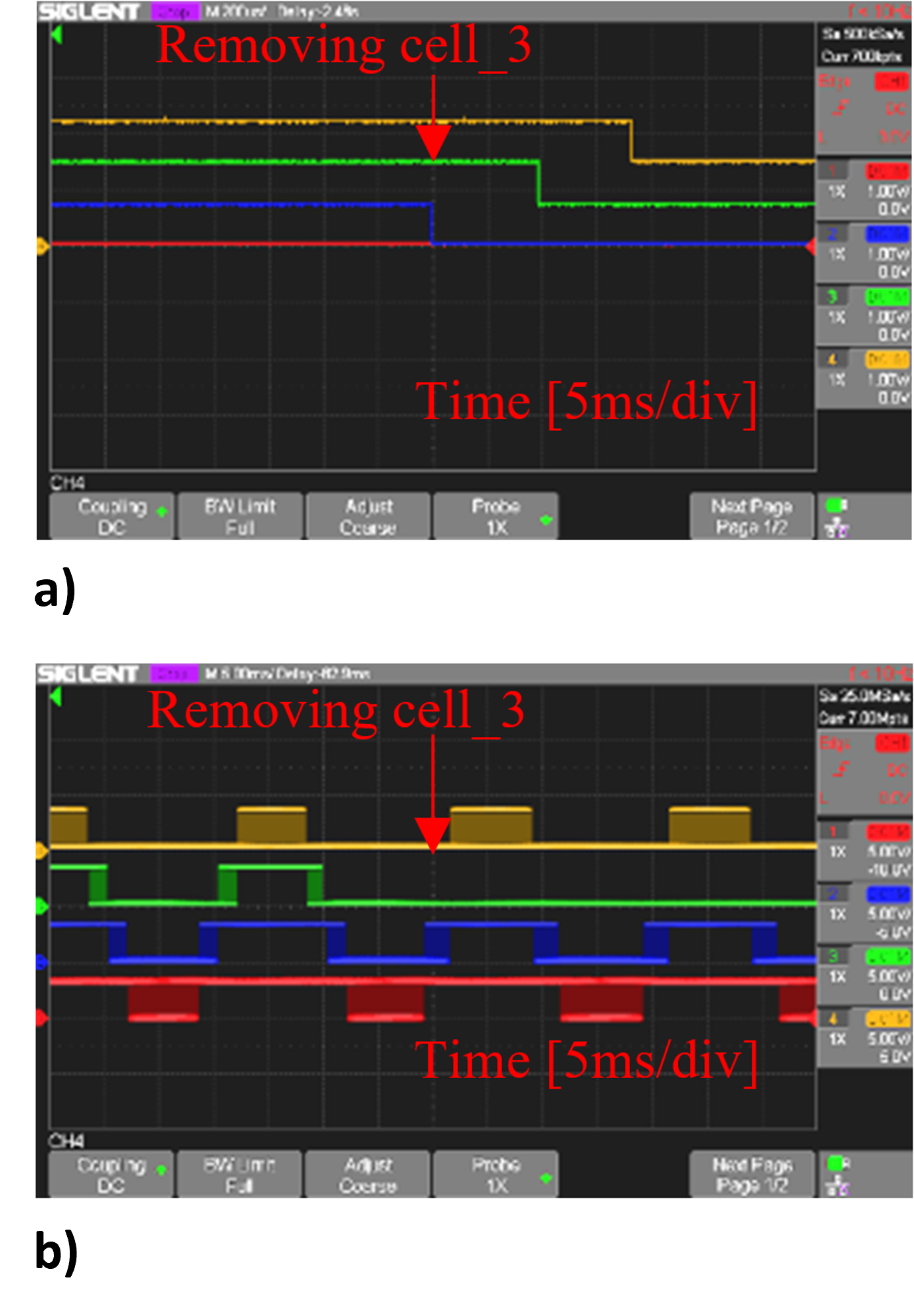
This study presents a space vector pulse width modulation (PWM) method for a multilevel single-phase decentralized power converter (DPC) called MSPDPC. The proposed model is built by connecting half-bridge cells in series. The output voltage can be adjusted according to demand by adding or subtracting cells. Cells use communication protocols to transmit and receive information with two neighboring cells. The received data contains information for the decentralized space vector pulse width modulation (DSVPWM) method proposed in this paper. In the proposed DSVPWM method, cells set up links to exchange information such as cell position, total cells in a phase, reference voltage amplitude, and reference frequency. The PWM control signals of each cell are calculated based on the information received. The study also focuses on evaluating the ability to adjust the switching vector and the corresponding dwell time of the cells when the structure of the DPC changes. The ability to dynamically reconfigure the DPC is a crucial feature that ensures uninterrupted power supply in case of one or several cell failures. The system automatically establishes a new state with the active cells. The proposed configuration and communication method between cells provide very fast configuration times. The load voltage of the DPC is adjusted to 0.5 times the voltage per cell, which allows the modulation voltage amplitude to be adjusted best according to the load requirements. The study used Matlab/Simulink software to review the initial assessments. The proposed model and algorithms will be verified on the Digital Signal Processor (DSP) platform with a 220V/500W load.