


Synthesis of Na3SbS4 solid electrolyte from aqueous solution and its application in solid state rechargeable batteries

- Faculty of Materials Technology, Ho Chi Minh City University of Technology (HCMUT), 268 Ly Thuong Kiet Str., Dist. 10, Ho Chi Minh City, Vietnam
- Vietnam National University Ho Chi Minh City, Linh Trung Ward, Thu Duc Dist., Ho Chi Minh City, Vietnam
- Faculty of Applied Science, Ho Chi Minh City University of Technology (HCMUT), 268 Ly Thuong Kiet Str., Dist. 10, Ho Chi Minh City, Vietnam
Abstract
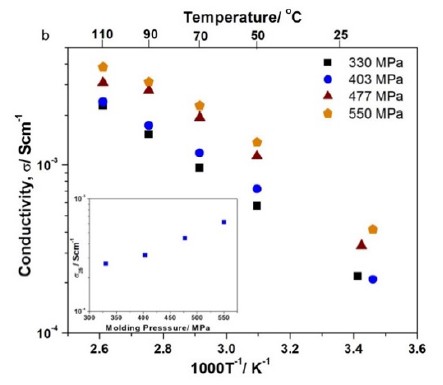
The tetragonal Na3SbS4 solid electrolyte was synthesized from aqueous solution in this study. The XRD results showed that the peak separation at 2θ = 30.1 and 35.1 º might from a defect in the crystal structure of t-Na3SbS4. The results of Rietveld analysis showed that the crystal structure of the Na3SbS4 sample after heat treatment belongs to the space group P-421c with the reliability coefficients Rwp=14.959%, Rp=11.690%. The lattice parameters are a = b = 7.1554(13) Å and c = 7.2829(13) Å. The pressure dependence in the pelletizing process of the ionic conductivity of the solid electrolyte t-Na3SbS4 was investigated and the pellets made at a pressure of 550 MPa had the highest ionic conductivity among the prepared samples, reaching a value of 6.0x10⁻⁴ Scm-1 at 25 ºC. The activation energies for the transport of Na⁺ ions in the prepared samples were 23, 24, 26 and 24 kJ mol-1 for pellets formed at pressures of 330, 403, 477 and 550 Mpa, respectively. These results demonstrate that the ion conduction mechanism is independent of the pellet forming pressure but the ionic conductivity at 25 ºC is directly proportional to those values. In addition, the electrochemical stability of Na3SbS4 was also evaluated through the discharge-charge characteristics of the battery cell TiS2−Na3SbS4|Na3SbS4| Na15Sn4. In the first discharge - charge cycle, the Coulomb efficiency was about 92.7% and higher than 99% from the second cycle onwards.