


Passivity - based control using genetic algorithm for a DC-DC boost power converter
- Ho Chi Minh City University of Technology – VNU-HCM, Vietnam
- Industrial University of Ho Chi Minh City, Vietnam
- Eastern International University, Vietnam
Abstract
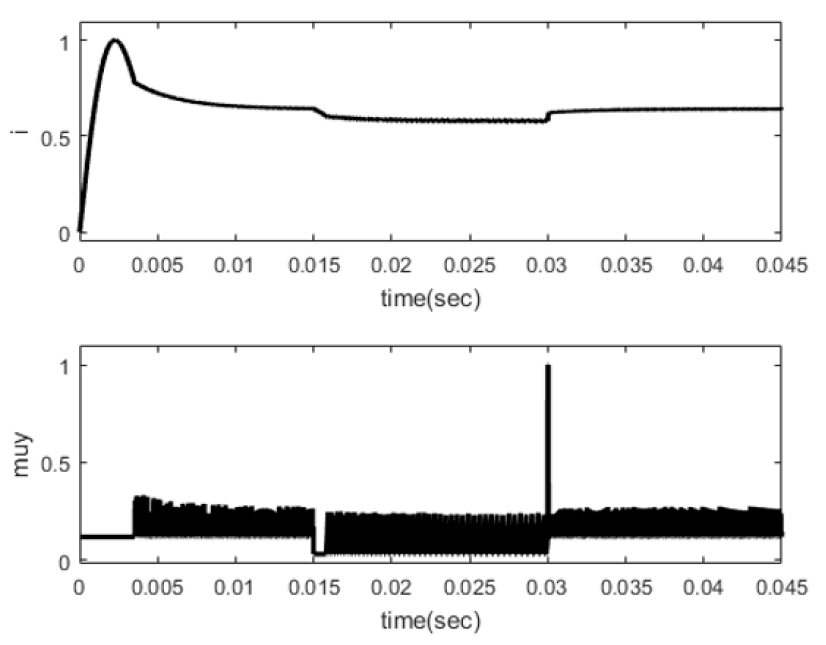
In this paper, a passivity – based control of a DC-DC boost power converter using genetic algorithm is proposed. The output of a DC-DC power boost converter is an inductor current. Its input is duty ratio . Using a co-ordinate transformation of state variables and control input, a DC-DC boost power converter is showed to be passive. A new plant is zero-state observable and the equilibrium point at origin of this plant is asymptotically stable. Then, a passivity - based control law is applied to this plant so that a voltage of capacitor x2 is equal to a value of desired voltage Vd when changing control input, duty ratio . The parameters of the passivity – based controller are also adjusted optimally by genetic algorithm using decimal encoder. Simulation results of a passivity – based control are good when the input voltage E, the load resistor R and the desired voltage Vd are varied. With variations of desired voltage Vd, the passivity – based controller supplies small value of IAE (integral absolute error of Vd and x2), small error, and short settling time Finally, simulation results show that the passivity – based control using genetic algorithm is better than the passivity – based control.